Who was Mary Anning, the Fossil Hunter?

Who was Mary Anning?
Mary Anning was a palaeontologist and fossil collector who lived in Lime Regis in Dorset, England, in the early 1800's. A palaeontologist (pronounced pay-lee-uhn-toh-luh-jist) is a scientist who studies the fossils of plants and animals to learn about the history of life on earth. Mary Anning made huge contributions to the science of palaeontology, making ground-breaking discoveries and influencing the work of many other palaeontologists at the time.
What was science like when Mary Anning was alive?
When Mary was alive (1799-1847), the science and history of living things on earth was not as well developed as it is today. Most people in England believed entirely in the story of the creation from the Christian bible, where god created all living things. A scientist called Georges Cuvier (who came to be known as the father of palaeontology) had recently introduced the idea of extinction. Extinction is where a whole species of living things dies out and disappears. Charles Darwin didn't publish his Theory of Evolution - the idea that living things adapt and change from generation to generation - until after Mary Anning's death. This meant that Mary Anning's discoveries were hugely ground-breaking because they contradicted everything people believed about the history of the natural world at the time!
What was it like being a female palaeontologist for Mary Anning?
Unfortunately, Mary Anning lived at a time when female scientists and historians were often not given full credit for their work. When male scientists bought and studied the fossils that Mary Anning had discovered, they didn't tell people that it was Mary who had found them, even when they wrote scientific papers about Mary's biggest and most important fossil finds. Also, Mary wasn't welcomed by the Geological Society in London - they didn't allow women to join the society until 1908.

Why did Mary Anning start fossil hunting?
When Mary Anning was a child, her family were very poor. Her father, Richard was an amateur fossil collector and took Mary to look for fossils with him on the beaches of Lyme Regis. The pair would clean up the fossils and sell them in her father's shop. When Richard died very suddenly, Mary's mother encouraged her to sell her fossil finds to make some extra money. The beaches in Lyme Regis were full of fossils called ammonites and belemnites. The rich Georgian tourists on holiday in the area loved these unusual fossils and would show them off to their friends.
What fossils did Mary Anning discover?
Mary uncovered fossil after fossil, many of which she sold. She also started the study of a type of fossil called a coprolite. Coprolites are fossils made from the poo of ancient animals! But during her life, Mary Anning made a number of very important discoveries, which included:

Ichthyosaur
In 1811, when she was just 12 years old, Mary's brother dug up an unusual-looking fossilised skull. Around a year later, Mary Anning spent several months searching for and unearthing the creature's fossilised body. The process took extreme care and effort from Mary, but resulted in a five-metre long skeleton that scientists first thought was a crocodile. It wasn't until 1820 that the fossil was understood to be an extinct marine reptile that lived hundreds of millions of years ago (like the Mosasaurus). It was named an Ichthyosaur - meaning "fish-lizard" - and was the first complete fossil of an Ichthyosaur to be found and studied to such length by scientists.
Plesiosaurus
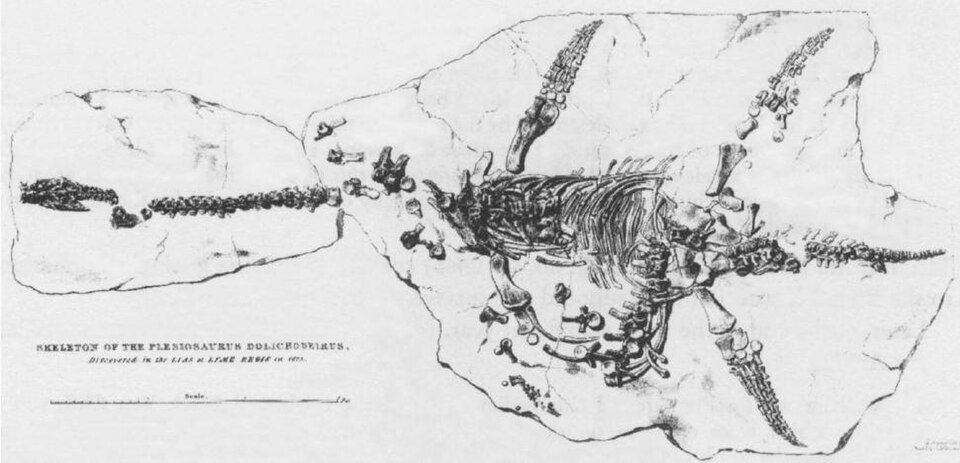
In 1823, when Mary was in her mid-twenties, she stumbled upon another exciting fossilised skeleton. This time, she had found the remains of a Plesiosaurus. The skeleton was so unusual that many people believed it was a fake at first! Even Georges Cuvier needed convincing of it's authenticity - he first believed that the specimen might have been two different skeletons squished together.

Dimorphodon
Just five years later, in 1928, Mary Anning discovered something else. This time, Mary knew the fossils she had found didn't belong to a marine creature. How was she so certain? Well this new specimen had wings. She had unearthed the first pterosaur fossil to be found outside of Germany. Pterosaurs are the largest flying animals to have ever existed on earth (like the Quetzalcoatlus). The Pterosaur Mary Anning found is now known as a Dimorphodon.
Why were Mary Anning's fossils so important?
Besides the fact that many of Mary Anning's fossil finds were the first of their kind in one way or another, her many discoveries fuelled public interest in palaeontology. The more interest in the subject grew, the more facts were discovered. Her finds inspired other scientists in their work. For example, geologist Henry De la Beche, a childhood friend of Mary Anning, was inspired to paint "Duria Antiquior - a More Ancient Dorset". This was the first time prehistoric life of earth based on fossil evidence had been shown in the form of a picture. Without Mary Anning's contributions, we may not know as much about the history of living things on earth as we know today.
Mary Anning's Legacy
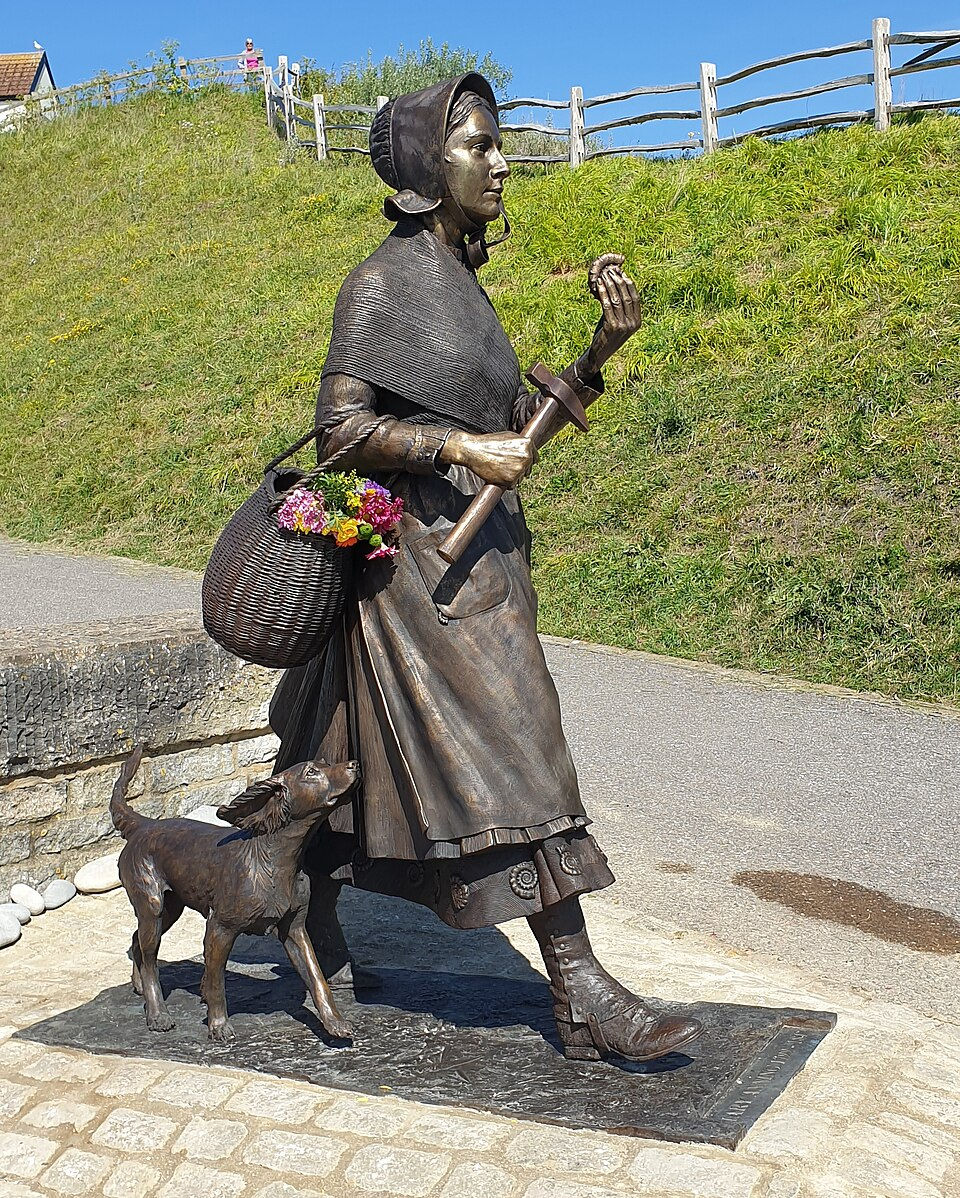
It wasn't until recent years that Mary Anning's contributions to palaeontology and geology have been fully recognised. In 2022, the project Mary Anning Rocks set out to remember and acknowledge Mary Anning and her world-changing work by erecting a monument in her home of Lyme Regis, Dorset. The life-size bronze statue of Mary Anning overlooks the beaches where she used to collect fossils, giving the local community and visitors to the area a place to show their remembrance and respect to this ground-breaking woman.


