How to Play Senet - Rules for the Ancient Egyptian Board Game
What is Senet the Board Game?
Senet is a board game played by Ancient Egyptians thousands of years ago. It’s thought to be the oldest board game in human history! Because the game is so old, the exact rules of how to play have been lost. But thanks to historians Timothy Kendall and R.C. Bell who studied plentiful ancient texts, we now have a modernised version of this historic game:

Aim of the Game
The game is played by 2 opponents with 5 counters each and a simple 30 square board. Like a fun combo of backgammon and snakes and ladders, in senet players have to get all of their counters from their starting squares (known as “houses”), through the numbered houses and then off the board at the end. The winner is the player to get all their counters off the board first.
You Will Need
A senet board

A senet board has 30 squares (known as “houses”) split into 3 rows with 10 houses per row. You can quickly draw out a basic senet board on a piece of A4 paper, or even make your own Egyptian-style Senet board with our craft activity. Make sure to number each house with numbers 1-30, with the top row of numbers reading 1-10 from left to right, the middle row of numbers reading 11-20 from right to left and the bottom row of numbers reading 21-30 from left to right. So, when playing, the player’s counters will move in a backwards “S” shape across and down the board.

10 counters
Each player has 5 counters each. The Ancient Egyptians used counters shaped like spools and cones. Make sure you can tell the difference between your counters and your opponent’s counters by choosing different colours or different shapes. You could use pieces from another board game (like chess pawns), coins, Lego bricks or chunks of coloured playdough!
1 Die or 4 Throwing Sticks
In senet, you can move up to 5 squares at a time. A bit like using dice, Ancient Egyptians used 4 throwing sticks to count the spaces they could move on their turn. You can make your own throwing sticks by grabbing 4 ice lolly sticks and colouring in one side of each stick.
When you throw the sticks, you can move one space for every stick that lands coloured side up, or 5 spaces if all your sticks land coloured side down.
Alternatively, use a regular dice and ignore the side with the 6. If you roll a 6, just roll again.
Set Up
The game starts with both player’s counters set up on the top row of houses (squares 1-10) on the board. Your counters must alternate with your opponents. So, your counters will either be placed on houses 1, 3, 5, 7 and 9 or on houses 2, 4, 6, 8 and 10.

The player with counters on 1,3,5,7 and 9 goes first.
To start the game, the first player throws the throwing sticks or rolls the dice and moves one of their counters the same number of houses as their thrown/rolled value. When you move your counter, follow the Rules for Moving Counters outlined below.
Once player one has finished moving their counter, it’s the second player’s turn to throw/roll and move one of their counters.
The game continues with each player taking a turn like this until one player moves all their pieces off the end of the board.
Nice and straightforward right? Time for some extra rules:
Rules for Moving Counters
Moving:
You can only move one counter per turn. You can’t split your throw/roll value between two or more counters on a turn.
If you can make a move, you must make it. Yes, even if that means you end up in the House of Water and have to go back to an earlier space (see Special Houses below).
If you can’t make any moves, you forfeit your turn and your opponent takes their next turn.
Jumping:

There can only ever be one counter per house. When you move your counter you can jump over other counters in other houses to reach the next free house. But bear in mind that each house you jump over counts towards your roll value. If the number you throw/roll can’t get your counter to the next free house, you won’t be able to move that counter. Try a different counter, or use the swap rule:
Swapping:
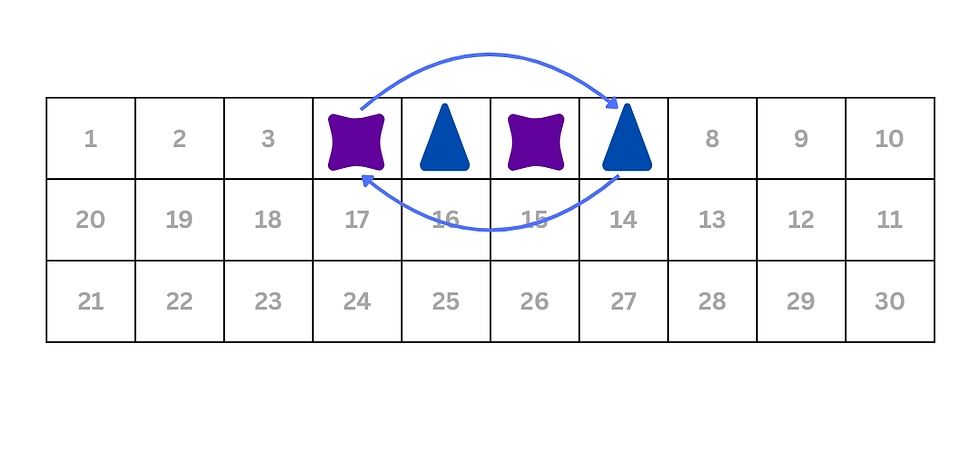
You can swap the position of one of your counters with the position of one of your opponent’s counters. Simply pop your counter in the house of your opponent’s counter and move their counter back to your original house. But you can’t just swap with any counter! Remember the number you’ve just thrown/rolled with your sticks/dice? You can only swap with counters that are the same number of houses away from you as your thrown/rolled value. EG. If you roll a 4, you can swap your counter with an opponent’s counter that is 4 houses away from yours.
You can’t swap with your own counters. Well you could, but there would be no point!
There are some cases where your opponent’s counters might be “safe”. In these cases, you may not be able to jump over them or swap with them. See the rules on “Safe Counters and Blockades” below.
Leaving the board:
Your counters can leave the board from houses 26, 28, 29 and 30. But you must throw/roll the exact value to leave the board from one of these houses.
EG if your counter is on house 29, you must throw/roll a 2 to leave the board. You can’t leave the board if you throw/roll a 3, 4 or 5. If you throw/roll a 1 you can move to house 30, but you must then throw/roll a 1 to leave the board from house 30.
Safe Counters and Blockades:
There are some situations where counters can’t be swapped or jumped over.
Safe Counters:

A safe counter is a counter that can’t be swapped. A counter is safe when:
It is placed in a house next to one of your other counters. Two or more of your counters in neighbouring houses can’t be swapped.
The counter is placed on houses 15, 26, 28 or 29. That’s because these are some of the special houses (see the rules for Special Houses, below).
Blockades:

Counters in a blockade can’t be swapped or jumped over by your opponent’s counters. A blockade is formed when you have 3 or more counters in a row in neighbouring houses. You can jump over your own blockade.
Special Houses

If you’re feeling confident with the above rules, you can add the rules for the Special Houses:
House 15 – The House of Life
Counters in this house are safe and can’t be swapped by their opponents. This house is the re-start point for counters that land in the House of Water (see below).
House 26 – House of Happiness
All counters must land on this house before being able to progress further on the board or leave the board. You must throw/roll the exact value to land on this house. Players can’t jump over or swap with counters on this house. You can leave the board from this house if you throw/roll a 5.
House 27 – House of Water
Uh-oh! Your counter just got washed away by the Nile! If you land on this house, your counter must go back to house 15 (see the House of Life, above). If house 15 is occupied by another counter, place your counter on the first empty house before it.
House 28 – House of Three Truths
Counters in this house are safe and can’t be swapped by their opponents. You can leave the board from this house if you throw/roll a 3.
House 29 – House of Twos
Counters in this house are safe and can’t be swapped by their opponents. You can leave the board from this house if you throw/roll a 2.
House 30 – House of Horus
Counters in this house are safe and can’t be swapped by their opponents. You can leave the board from this house if you throw/roll a 1.
Add a Challenge:
If you’d like an even trickier version of the game, houses 26, 28, 29 and 30 can act as traps. They trap their opponent so you can’t progress any further unless you throw/roll the exact value to leave the board.
Add an extra rule: You can’t cut short your throw/roll value. EG if you roll a 3, you must progress one of your counters by exactly 3 houses, not 2 or 1.


